Friday, April 27, 2007

Little Debbie, Sallie Mae and Wendy Play the Three Furies


This morning I woke up and ate a Little Debbie's choco-marshmellow dessert snack with my coffee. Since then, I have pretty much decided that it is the most unhealthy food ever. I don't even think it should properly be called food. Little Debbie is the most innocent-looking little girl since the Coppertone girl who perpetually gets her diaper ripped off by a dog. Does anyone remember that ad? What happens when something bites a diaper? No good can come from that. Who in the world thought that up, and why would it ever be considered a good idea?


But back to Little Debbie—she always has a snack for you. She wants you to be fat and die of scurvy (while consuming oatmeal pies).

Then, instead of eating lunch, I spent two hours sitting in an exit-loan workshop at USC, listening to how Sallie Mae owns me for at least ten years. TEN. For many students, it's TWENTY-FIVE. Favorite fun fact: only 7% of students make all of their payments on time over the first three years of a loan. Sallie Mae is worse than Little Debbie, so much so, that I could only find this picture:


Don't let the look take you in. She will garnish your wages and steal your income tax refund in a heartbeat. (Cliché alert.) I'm pretty sure she is the Irish mafia.

For dinner, I only wish I would have eaten at Wendy's. That little red-haired minx is just as devious. I heard they have replaced the buns with deep-fried choco-marshmellow paddies.


Instead, I had Mexican food.

Thursday, April 19, 2007

Why MySpace Boosts My Self-Esteem

Yes, I admit it. I have a MySpace account. I'm not really ashamed of it, either. I really love the principle of networking centered around artistic communities like musicians and writers, and sharing your work via the network. It still is taken advantage of—because of the lack of an individual verification system like Facebook has. You can say or be anyone on MySpace, which I suppose is what makes the internet a vicarious and scary place. It's interesting, though, because many people take this to another level, where they are almost mocking the principle of "be anyone." How many profiles have you seen that are "99-year-old female" who makes "$250,000 or over?"

I get a lot of friend requests on MySpace—probably at least two a day. Yes, all of the porn stars and entrepreneurial stock broker and drug company types want to be my friend. I can only conclude from this that I am CEO material encaged in an übersexy body. The best friend request, though, was the following:


I have nothing else to say about that.

Final Project and USC are Done

My final project, though flawed, is complete and approved. So, unless the committee decides to turn it down (very unlikely), I have completed all the requirements of the MPW degree. I'm going to start calling it an MFA, just to avoid confusion. Also, it makes me feel as if I didn't waste money on the degree.

In other news, I will not be attending a PhD program in the Fall. All three turned me down, although the rumor is that I was "close" at USC. They accepted 2 out of 80 applications; so I'm not surprised. I would have loved to stay at 'SC and work with the incredible PhD faculty in the English department, but it looks like I'll have the first year completely off from school since kindergarten.

My responsibilities as a TA are wrapping up and I'm looking forward to the summer and trying to get a story or two published.

Sunday, March 11, 2007

Neon Bible


Montreal's finest rock band, The Arcade Fire, has only boosted its reputation as indie hero with the release of their second full-length album. Neon Bible features two songs with partial French lyrics, weightier religious themes, and an expansion of musical sources. "Intervention" pulses with the verve of a pipe organ, while "My Body is a Cage," is backed by a gospel choir. Of course the violin and accordion return. Songs build melodic layers on top of one another until what emerges is much more than the mere parts.

If you dislike analysis of art, you should consider skipping to the last paragraph. If not, then by all means continue.

Perhaps the most significant shift from Funeral is the inclusion of explicitly religious language, imagery and themes. The title track "Neon Bible," seems to struggle with finding the place of Christianity within contemporary culture. The image of the red and black neon bible is something normally found on the Vegas strip rather than in a sanctuary. Does Christianity have to be flashy and exciting to attract attention? Didn't it work for The Passion of the Christ?

In some ways, it all feels antithetical to the image and feel presented by the band. This is not The Killers, Vegas' poster band, one of edgy clothing, makeup trends and power guitar hooks. That's who should have released a record called Neon Bible. Instead, we get the subtle genius of intermingled instruments and the casual fashion sense of a discount vintage shop or a discovered attic. Don't be jealous, Mr. Brightside.

If "Wake Up" established the group as authors of epic anthems, Neon Bible walks the balance beam of personal and universal without losing a sense of urgency or significance. "(Antichrist Television Blues)" tells the personal narrative of a man exploiting his daughter, all the while asking for divine affirmation. "Lord would you send me a sign/'cause I just gotta know if I'm wastin' my time." "Ocean of Noise" is a story of personal reconciliation encompassed by questions of free will versus determinism. "Black Mirror" laments the difficulty in escaping from the perceptions and language of the self. The black mirror "casts my reflection everywhere." Watch out, the black mirror might be you!

Yet throughout, the album manages to escape an introspective focus. "Keep the Car Running" bursts with pace, suggesting a temporance to life on earth, and expressing a sense of dissatisfaction with the way the world is. If anything sounds like a generational anthem, this is it. In this context, the inclusion of "No Cars Go," a revised song from the band's first, self-titled EP, makes perfect sense. I had always taken "No Cars Go," as a reference to Heaven. Like U2's "Where the Streets Have No Name," a literal Heaven may not be the only reference point. Rather, a convergence between earthly and divine—a meditative state—"between the click of the light and the start of the dream." Religious experience, especially in a culture that values bright city lights and shiny packages, is uncommon—but this album takes us there.

This is the best CD I have purchased this year, and I wouldn't be surprised if it survives as one of my all-time favorties.

Saturday, March 10, 2007

Books Make You Fat...


CNN recently posted an article on how Pizza Hut may be contributing (deviously) to obesity in children through their reading program called Book It! Kids get a free pan pizza every time they meet a reading goal. As a student, I remember this program. I got a holographic button with star stickers on it. Since I read non-stop, I got lots of pepperoni pizzas. I am secretly hoping this comes to a class-action lawsuit. I'm not asking for much, Book It! (just a personal trainer).

Thursday, March 01, 2007

2006 Story Prize


Mary Gordon
won $20,000 for her career-spanning collection The Stories of Mary Gordon. The story that Gordon read during the award ceremony featured a podiatrist and a wolf mistaken for a dog. Tragic and funny! Actually, this is now going on my list of things to read. The list is pretty long and often interrupted by the psychology of love and attachment. Attached, but not in love. Fitter, happier, more productive. A pig, in a cage, on antibiotics (thanks Radiohead).

This is the largest monetary award given for fiction in the U.S. How nice would it be to win? I like that it is only open to collections of short stories. The New School in New York sponsors this competition, which debuted in 2004. Viva la short story.

Monday, February 26, 2007

Story as Performance Art

This is one of the most interesting pieces I've seen in a while. Author Shelley Jackson has taken volunteers to get one word of the 2,095 in her story "Skin" tattooed on his or her body. The story is sent to each participant upon completion of the tattoo. So far, over 10,000 people have expressed interest. Several hundred have all ready been inked. Jackson only sends the story to participants; no one else can read it. She also refers to participants as "her words" and says that she will "make every effort to attend the funeral of a word."

This appeals to me, but I had to think for a few minutes to figure out why. Every author wants (on some level) this kind of intense reader response when they write. A tattoo is pretty intense. Although, I suppose good literature does change people's lives--or at least people's perspectives on life, which is just as good. At what point does this desire turn into unhealthy arrogance? Does calling participants "words" marginalize them? It seems strange to me. Almost as if, when a word dies, Jackson feels that a part of her story has died too. (Really, should one be worried about a tattoo when a person has died.)

In short, I love the creativity but wonder about the motivation. Also, I love the way these typical fonts look on skin. Some of the tattoos, and a description of the project, are available for viewing here.

Saturday, February 17, 2007

Recently Learned...


My reading of the first papers for my TA class yielded the following gems. Really, this makes my grading so much more enjoyable.

King Henry the VIII was the King of Whales. This was by far my favorite. He was pretty portly, but the King of Whales is taking it a bit far.

King Henry reigned "in the time of England." (Obviously a long time ago.)

Ever wondered what Gandhi's first name was? I learned it: Mohammed. Yes, Gandhi experienced a spiritual conversion late in life.

Friday, February 09, 2007

Gathering (a poem)

Stand in Notre Dame Cathedral if you like, or Westminster—
windows cast brilliant Mondrians on the floor,
though I prefer Sacre Coeur, a small, dark place
where light springs from circular portals,
convincing everyone that glowing is the beginning of beauty.

We are mere shards of a colored pane—
not dropped exactly, yet broken.
A dirtied mirror, even when pointed at the sky,
reflects light only poorly. Who can see it? We
do not believe in bad luck, but certainly in evil.
You ask how one becomes many
on its own. A troubling question:
How did the first cell divide?

John recorded the beginning: be one, even as We are.
East and West shout across a frozen lake;
ears strained from such a distance:
"We will tell you where Spirit comes from."
The stained glass window cracks—then fractures,
nail pounded into door, sword into flesh.
Corruption petitions the night for indulgence—
the king is sharpening his axe!
"I will marry whomever I want."
We scream and scream, and, and, and, and:
"We do not like the way you paint or sing."

Glass bits fly out to sea-worthies,
cross into an experimental world, settle into the dust—
we prefer our secluded corners and cracks.
Convenience has created multicolored grains of sand—
coming soon to a beach near you! Sing praise!

I have taken to washing windows on the sides of skyscrapers—
hoping that one day, after removing the stain of grime,
the stain of colored glass will be revealed.
Though they reach toward Heaven, they are not
another of Cana’s wonders. Still—
set aside the best till now—imagine
reflections from a building made all of glowing windows.

Thursday, February 01, 2007

Word of the Day: Portmanteau


Portmanteau: 1) a large suitcase with two compartments. (Apparently very archaic and rare.) This is the definition I know, probably from reading 19th century novels. I think a traveller could carry pretty much anything in a portmanteau. I would carry gold in mine, if I had one. And if I had gold.

2) the combination of parts of two or more words into one, which yields a new meaning. e.g. Lunch and Breakfast into brunch, or smoke and fog into smog.

Lewis Carroll's poem, "Jabberwocky," famously uses lots of portmanteaus.

All of this makes me want to own an actual leather portmanteau, but it would have very little practical value. I wonder if I could keep files in it?

Yes, I learned most of this from wikipedia.

I also suggested this for the title of the new USC literary journal. I hope it wins, but maybe it's too French-sounding.

Tuesday, January 30, 2007

U2 as Worship Music?


I can't believe it took me four months to hear about this...

There is a book of sermons incoporating U2 lyrics as the main teaching points. I assume many have to do with social justice, which is certainly something the church should discuss more.

But there's more. I'm as big a fan of U2 as anyone, but I'm not sure what I think about this. The Episcopal church has been using U2 songs as part of a special Communion service. Apparently, over 150 churches in seven countries have done the service. It's not that I challenge the religious conviction of U2, but rather wonder about the validity of using songs not expressly written for worship. It raises the question of aesthetic use and interpretation. Is it legitimate to re-interpret U2 songs in a much more sacred context? Can a song about a sugar-daddy ("Daddy's Gonna Pay for Your Crashed Car") be re-directed toward God? Or what about "Beautiful Day?"

During concerts, including two that I attended, Bono has said "let's take it to church," setting a tone of worhip or at least meditation for the show. Several songs, including "40" and "Wake Up Dead Man," are meant to be taken as prayers, although "Wake Up" is almost a prayer without hope. Other songs have a distinctly religious component, but more as an exploration of spirituality rather than a decided, worshipful attitude.

Should worship be an expression of certainty, or can it express doubt? How much does authorial intent matter in worship? More than in general, or just the same? Certainly not less.

I am all for trying to make the church more culturally relevant, and it's hard for me to reject U2, because I think they are the best music group today that profoundly addresses Christian themes. But I still have a hard time with this. Maybe I have some liturgical reservations.

Saturday, January 27, 2007

Books for Psych 200: Love and Attachment

Here are the books that are assigned for the class that I am TA-ing:


I could tell that students had been buying these books together from Amazon, because the customer info linked all of them together. I have read the first two already. It's interesting stuff. The first film we showed was A Man for All Seasons, which is the story of Thomas More's execution at the hand of Henry VIII, for More's refusal to acknowledge the validity of Henry's second marriage and his role as head of the Church of England. The film's connection seems to be a portrayal of someone irrationally attached to an idea (religion) at the expense of his life.

I hope I learn something about love and attachment from this class. Apparently, I need all the help I can get.

Evangelicals: American Fascists?


I was listening to NPR (89.3 for those in LA) this week and they were interviewing Chris Hedges, the author of a recent book, that draws comparisons between the situations in pre-Nazi Germany, pre-Mussolini Italy and the current US. The interviewer was listenly, very seriously, to Hedges' animated rhetoric, comparing Pat Robertson, Jerry Falwell and James Dobson to a) Nazis and b) Islamic terrorists. If these Evangelicals had their collective dastardly way, Hedges said, homosexuals and Muslims, in addition to anyone else who didn't agree with the most conservative agenda, would be jailed or thrown into concentration camps. It was all conducted very matter-0f-factly.

It struck me as strange that a credible news program would present such seemingly outlandish claims as plausible. Never did the interviewer challenge Hedges or even ask him to clarify his position. She ate it up.

I was so intrigued that I went to Border's and read most of the first chapter. Hedges was raised as the son of Presbyterian minister, and went to Harvard Divinity School. He obviously is familiar with the Bible and Christian doctrine. His main problems seem to be that he views God as a God of mystery, the Bible as a good, but ultimately contradictory book, moral absolutes as deadly, the hope of Heaven depressing in living an earthly Christian life, and conservative Evangelicals who differ from him as simplistic if not the demon spawn of our country. In reading this, I realized that this view of conservative Evangelicals is probably not that far from the mainstream, liberal view.

Some of Hedges' points seemed grounded. To be fair, he estimates only about 20-25% of Evangelicals as potentially fascist. He labels these "dominionists," who see America as "God's country," who take books like Left Behind literally, who believe in conversion of the unsaved at any cost, who believe in strong, masculine leadership, and who look to a utopian Heaven as fulfillment (and apparently don't care anymore about their earthly lives).

I suppose if all of these were added together, a culture of fascism could occur. But Hedges seems to assume several things that just don't seem to be the case. I am hardly one to endorse Robertson or Falwell, but even they don't seem fully capable of the kind of extremes of Nazi Germany. Morever, Hedges seems to form a correlation between belief in moral absolutes and other fascist characteristics (militarism, self-sacrifice, and etc.). This just seems false. Moral absolutes may be passe or cliche in today's Blue Like Jazz Christian culture, but they are no fascism. Moreover, God Himself, although He may be inscrutable and certainly mysterious at times, does deliver edicts that turn out to be moral absolutes. God's character is morally absolute. Viewing homosexuality or abortion as always wrong does not mean that abortion clinics should be bombed or that gays and lesbians should be punished with the death penalty. Apparently, evangelicals could do more to show their compassion to the wider culture.

This problem of underestimating God comes through too in Hedges' portrayal of Evangelical believers. He tells the story of one convert who was sexually abused early in life, before "finding Jesus." For her, life on earth has let her down, and she looks forward to life in Heaven as a chance to be perfected as a person. Hedges presents her as already having given up on her earthly life. To me, this underestimates God's power to really change and redeem people here on earth.

In any case, I look forward to checking this book out from the library and giving it a proper review. I also encourage you to read it, because it seems to reflect a political view of Evangelicals that is held throughout our country.

Thursday, January 11, 2007

Employed Again...

So USC decided to give me a TA extension after all. Sort of. Due to the amount of students wanting to add the class, administration added a fifth TA to a GE Psych class called "Love and Attachment". I will be the fifth TA. Does anyone see the irony in this? Anyone?

The professor seems to hold to a sort of reductive evolutionary explanation for human behavior, including love and emotional attachment. This should be an interesting experience, although Scandalous Ethics might have been more fun.

I hope it all goes well, and I won't have to eat Ramen noodles all semester.

Tuesday, December 26, 2006

Cold War Kids on Letterman


CWK took the stage in NYC for the Letterman show on 12/22, following news anchor Tom Brokaw. My favorite part is at the end, when Dave asks the band where they are from and Maust responds "Long Beach," even though I was hoping for a Whittier shout-out.

The other best part wasn't on this video, but happened before Brokaw came out. Paul and Dave were talking and Paul said "Cold War Kids are my favorite band, and you're going to see why tonight."

Nice to get some late night love. Soon to come, Leno and SNL.

Thursday, December 21, 2006

A Myth Concerning Darwin


1.
Darwin evolved into God after breeding with the elements,
each one alone, until he combined them in his harem—

seducing Fire with promises of virgin timber,
whispering sonnets into Air’s ear,
massaging Earth with his fingers.

But Water would not be won with words or presents—
she felt she was too good for him,

running away as a vapor when he tried to kiss her,
squirming and squishing free from his embrace,
falling at his feet in mock surrender as the rain.

At last he caught her at Lake Grasmere,
but he only slipped on her frozen back, bruising his tailbone.

She held him captive in her hand for five years on the Beagle,
until he agreed to make her queen and mother of his firstborn.

2.
Darwin sat in Heaven, observing the world,
eyes full, mouth with smiling teeth—

particularly enjoying shed cocoons,
the way the pigeons hovered at Trafalgar Square,
and the barnacles that clung to rocks to spite the sea.

It is revenge on Water he proclaimed and laughed—
then later, cried,
he could not make love to her in Heaven.

He took out a blindfold to cover his eyes,
but he saw through it.

He tried to cut himself so that blood would fall to the air,
but his skin was impenetrable.

At last he came to the realization that he could no longer
do anything except watch.

Sunday, December 17, 2006

A Fairvilla Christmas


Nothing says merry like sledding and sweaters.

Tuesday, December 05, 2006

A Story about Stories: Holy Days/Holidays

The semester is over at USC. I have no coursework left for my MA. All that remains is grading and a final exam that I have to proctor. I am now transitioning into writing my thesis, a collection of short stories that focus on the way holidays change over time. Sometimes these shifting conceptions of holidays simply reflect cultural patterns (the merchandizing of the early 20th century or 1950s), but in other cases larger ideological shifts are reflected (the secularization of religious holy days, more cynical views on holidays like Valentine's Day or New Year's resolutions).

I have drafts of five stories, two of which have been rewritten. If anyone wants to look at one or two and give me feedback, I would love to hear your opinion.

In other news, I am also applying for grad school again. This is what? Round five? God willing, it will be the last time, following which I will be granted a PhD.

Friday, November 17, 2006

Molting (a prophecy)


1. Hermit Crab

The picture carried in my wallet is worn out—
crease turned black, edges frayed, corner ripped,
but increasingly agreeable.
A memory like cracked glass,
paint thinner poured over a favorite oil portrait—
the colors hemorrhage.
Someone has written on the back in red ink,
suffering is holy.

In the picture I was only sixteen,
drunk on inhibition.
They gave me a license anyway,
waved hands vaguely in the region of…
Do whatever you think is best.
Buy a sports car, use a condom.
Live.


(I thought nothing was best.)
Awake and not—
I lay on dirty sheets/twin bed,
birthed the sensation of never landing—
cryptic night presence,
skin pale in walled isolation,
the need for plummets to breathe.

Always searching for some new shell.

2. Garden Snake

Walking with/in her fingers,
under the boisterous sun on the beach,
my skin collapses, sloughs off,
her touch chars prints of my identity.

I seemed destined for colder climes—
Ocean corners, Midwest blizzards.
A bottom-dweller for whom light has no meaning.
A withered codger sipping coffee from a paper cup
as the outdoor children build a snow fort.

In a quiet condo,
away from the 5 freeway,
green with long rain gutters along the roof,
the water will not touch us.
We sit and talk on overstuffed couch,
the comfort of being mutually found,
sleep better during the day,
wake as the sun surrounds the curtains.

Sometimes basking in the flowerbed.

3. Albatross

The picture is scanned and digitally altered,
crease removed, edges brightened, corner straight.
I have captioned it:
Me.

On the day after Thanksgiving
I wasn't thankful enough.
Hands in pockets, I perch on the mall's escalator,
watch the pretty girls shop,
how they move,
the way their hair holds light.
All of them memories.

I worry that not enough know how beautiful they are.
A secret to be shared over Spaghetti Bolognese,
chianti, round candles.
How beautiful,
this ignorance.
I cannot tell them.

Not flying again until pinfeathers
push the dead fluff away.

Thursday, October 26, 2006

A Brief History of Blog (as portrayed in 1950s monster movies)

Blog was born some time ago, and right away we infer that his parents must have hated him since they gave him such an ugly name. They must also have been Trekkies or yacht-racers, since the only people that use "log" as a synonym for diary are nautical types or sci-fi lovers. I figured someone must have taken this to the next step, and yes, I have found the Captain's Blog :stardate, now. The captain is a proponent of some AMAZING conspiracy theories, including, but not limited to, the idea that terrorists (or someone like them) are controlling hurricanes and directing them toward the U.S.

But consider the alternatives: Web + Diary = Wiary or Biary. Actually, Biary isn't so bad-sounding, but the one virtue of Blog is that it's short, whereas Biary is more than one syllable. No one could be expected to say more than one syllable in such a fast-paced world as the one that Blog inhabited. He lived in the town of Cyberspace, which is not much like actual space, but it tries hard. Another option would have been Web + Journal = Wournal or Bournal. Neither is short, and both are ugly. I blame Roget (when in doubt, the French can easily fill in as scapegoats) for not coming up with enough synonyms for diary. Although, it does also list record, memoir, account and chronicle. With these more obscure options I was able to come up with Bord, Boir, Woir, Wount, Bicle, and Wicle. How can you argue against Wicle or Boir? If you have a good case, I want to hear it. Now, please. Both of the aforementioned so far surpass blog that I demand a revolution. Maybe I will place an internet poll somewhere where all five of you reading this will find it and vote for either Wicle or Boir.

I digress; this article was about Blog, not those trying to overthrow him. Anyway, Blog got his big break in 1951 with "The Thing." (see how a specific, brilliant liguistic decision can make a career?)


Blog, looking like Frankenstein's monster with horns. Note, Blog is even scarier-looking out of costume.


In 1954, Blog was given another great role, this time as "the creature." Slightly less ambiguous!


Blog, trying to pull himself out of the swamp of ugly (where he still lives, by the way), from the film "The Creature from the Black Lagoon". The swamp of ugly is also where most of Blog's writers live.

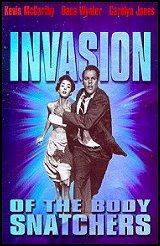
For a while, Blog went unnoticed, but after two hit films he could not stay hidden, even in the swamp of ugly. In 1956 he did not appear, but was given creative credit in, "Invasion of the Body Snatchers."


When asked why Blog was credited, even though he never appeared in the film, director Don Siegel stated that "Blog has a tendency to take over people's lives, just like the body-snatchers."

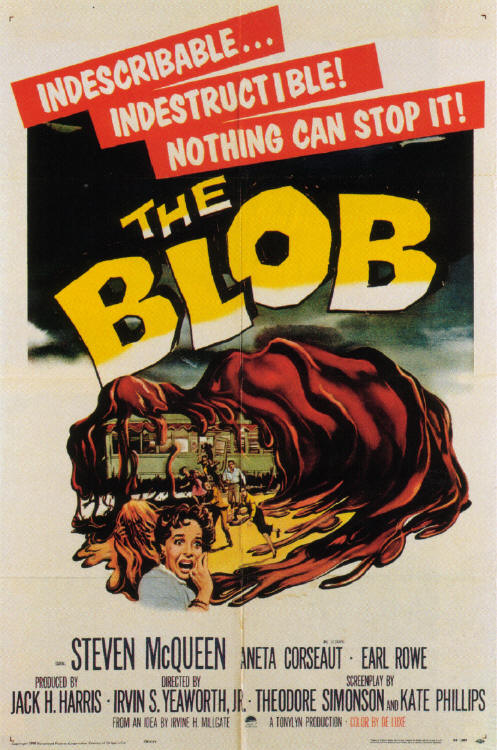
The 50s were busy years for Blog, who in 1958, won the leading role in "Blob."


Here is Blog as "Blob," trying to eat, or perhaps absorb, the world. Please note that this is also Blog's real-life aspiration.

Blog's movie career was never the same after the 50s, although he went on to "Son of Blob" (1972), "Harry and the Hendersons" (1987), and occasional guest spots on "Alf".

Today, Blog has moved on to more-disturbing roles in politics and professional snooping. He is currently a featured profile on MySpace and enjoys internet, but not actual, dating. In person, he is too terrible and ugly to look at.